
When a critical hydraulic component fails, the clock starts ticking. Every minute of downtime costs money, whether it’s a production line grinding to a halt or a vital piece of construction machinery sitting idle. Finding a replacement isn't just about getting any part; it’s about getting the right part, fast.
This guide is for the engineers, MRO teams, and procurement managers on the front line. We'll cut through the noise and show you how to navigate the world of UK hydraulic equipment supply. Think of your hydraulic supplier as a crucial partner in keeping your operations running smoothly. A weak link in that chain, and everything downstream feels the pain.
Your Guide to Navigating UK Hydraulic Equipment Supply
Working with a specialist supplier, like our team here at MA Hydraulics, means your projects in agriculture, manufacturing, or heavy industry don’t have to suffer from costly interruptions. We'll walk you through the practicalities: choosing the best components, spotting a truly reliable supplier, and knowing when a bespoke solution is the only way forward. It's the knowledge you need to keep your hydraulic systems in peak condition.
A Growing Market Demands Reliable Partners
The UK hydraulics industry is in a period of solid growth. For anyone who relies on hydraulic power—from mobile plant to factory machinery—this expansion isn't just a statistic. It’s a signal that having a dependable hydraulic equipment supply partner is more important than ever. When a machine goes down, it’s not a minor headache; it's a direct blow to your bottom line.
The numbers back this up. The UK hydraulics market was valued at £1,280.9 million in 2024 and is forecast to climb to £1,687.3 million by 2035. This steady 2.54% compound annual growth rate (CAGR) is heavily influenced by the sheer scale of the mobile hydraulics sector. You can explore further details about this growing market and see what it means for UK industry.
The Core Challenge for Engineers and MRO Teams
If you're an engineer or part of an MRO team, you know the real challenge isn't just finding a part. It's getting the right part, right now. The fallout from a poor supply choice can be immediate and severe:
- Costly Downtime: A single failed hose or valve can shut down an entire operation.
- Incorrect Specifications: The wrong part is worse than no part. An incorrect pressure rating or a fitting that's a millimetre off means more delays and risks damaging the whole system.
- Obsolete Parts: Tracking down components for older, but still essential, machinery can feel like a full-time job.
- Lack of Technical Support: Sometimes you don’t just need a part; you need advice. Without it, you could be fitting a component that isn’t the best or most cost-effective choice for your application.
A good hydraulic supplier doesn't just shift boxes. They should feel like an extension of your own technical team, ready to help you solve problems and keep your machinery running at its best.
This guide gives you the insight to build a supply chain you can truly depend on.
Understanding the Core Components of a Hydraulic System
Every piece of hydraulic machinery, whether it’s a tipper trailer on a farm or a colossal industrial press, works on the same fundamental principles. The best way to think about it is like a team, where each part has a very specific role. Getting to grips with how these parts work together is the key to properly maintaining, troubleshooting, and sourcing the right bits from a hydraulic equipment supply expert.
At its core, a hydraulic system is all about using a fluid to transmit immense force. But it’s the clever interaction between the components that turns this simple concept into the powerhouse behind modern industry. Let's get acquainted with the key players.
To help you quickly identify the main parts and what they do, here’s a quick-reference table. It breaks down the essential components you'll find in almost any hydraulic setup.
Key Hydraulic Components and Their Functions
| Component Category | Specific Examples | Primary Function in the System |
|---|---|---|
| Flow Generation | Gear Pumps, Vane Pumps, Piston Pumps | To create the flow of hydraulic fluid, acting as the heart of the system. |
| Control | Directional Valves, Pressure Relief Valves, Flow Control Valves, CETOP Valves | To direct, manage, and regulate the fluid’s pressure, direction, and speed. |
| Actuation | Hydraulic Cylinders (Rams), Hydraulic Motors | To convert the fluid’s energy back into mechanical work (linear or rotary motion). |
| Fluid Management | Reservoirs (Tanks), Filters, Coolers | To store, clean, and cool the hydraulic fluid, ensuring system health and longevity. |
| Connection | Hoses, Pipes, Fittings, Bellhousings, Drive Couplings | To connect all components, contain the fluid, and link the pump to the power source. |
Each category is vital. A failure in one area, like a clogged filter, can quickly cause catastrophic damage to expensive components like the pump or valves.
The Pump: The Heart of the Operation
There's a common misconception that a hydraulic pump creates pressure. It doesn't. Its real job is much simpler, yet absolutely critical: the pump generates flow. It's the system's heart, pushing the hydraulic fluid—the machine's lifeblood—around the circuit.
Pressure only builds when that flow meets resistance, like trying to lift a heavy load with a cylinder. The pump itself just keeps on pumping, delivering a steady volume of fluid. The type of pump you need is dictated entirely by the flow rate and pressure your application demands.
- Gear Pumps: These are the dependable workhorses of the hydraulic world. They are simple, tough, and cost-effective, making them a go-to for countless mobile and industrial jobs.
- Vane Pumps: Known for running much quieter and with a smoother output, you’ll often find vane pumps in places where noise levels are a concern.
- Piston Pumps: These are the high-performance athletes. They can handle incredibly high pressures and offer variable flow, making them perfect for complex, heavy-duty machinery.
Valves: The Brains of the System
If the pump is the heart, the valves are definitely the brains. They are the decision-makers, telling the fluid exactly where to go, when to go there, and how much force to apply. Without valves, you’d simply have oil flowing uselessly in a loop.
Valves are what allow an operator to precisely lift a multi-tonne load, steer a vehicle, or clamp a part. They manage the fluid's direction, pressure, and flow rate.
A hydraulic system's performance is only as good as its control. High-quality valves ensure that the raw power generated by the pump is channelled into useful, repeatable work, preventing shocks, overloads, and inefficiency.
Any good hydraulic equipment supply partner will have a huge range of these on the shelf, from simple on/off directional valves to sophisticated proportional valves for fine-tuning speed and force. CETOP valves, for example, are a mainstay in industry because their standard mounting pattern makes them easy to swap out.
Actuators and Motors: The Muscles
Now for the part that does the actual work. Actuators are where all that hydraulic energy gets converted back into physical force. These are the "muscles" of the system, doing the heavy lifting, pulling, pushing, and turning.
You'll mainly encounter two types:
- Hydraulic Cylinders: These turn hydraulic power into straight-line (linear) motion. Think of the arm on a digger or the ram inside a workshop press.
- Hydraulic Motors: These convert the fluid's energy into spinning (rotary) motion. They are used to power anything from conveyor belts to the drive wheels on a forklift.
The infographic below offers a bird's-eye view of the factors currently shaping the UK's hydraulic supply chain.
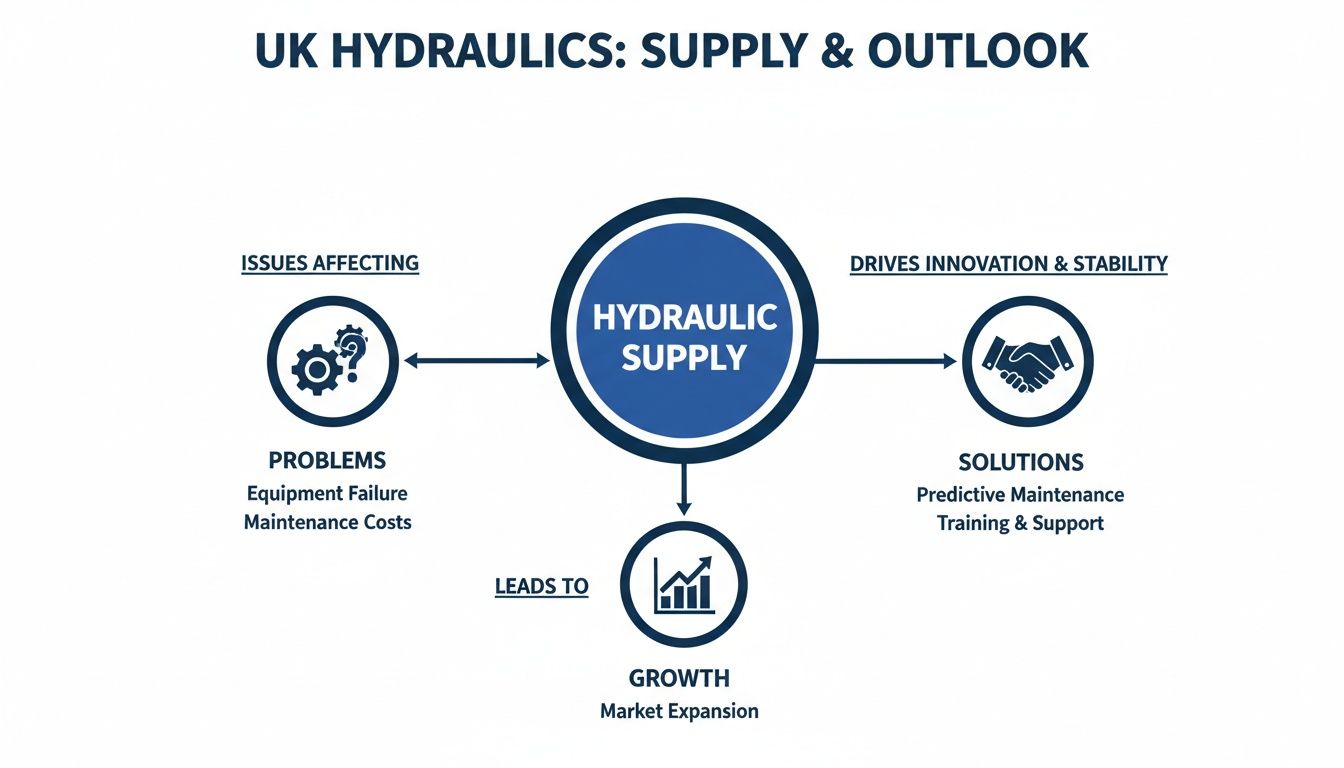
It highlights how focusing on complete solutions and planning for growth is the best way to navigate the challenges of sourcing parts and designing reliable systems. For anyone building a machine from scratch, seeing how these components fit together is crucial. You can see how we package them into a single, integrated system in our guide to the hydraulic power unit.
The Supporting Cast: Reservoir, Filters, and Connections
Of course, none of this works in isolation. Every system needs a support network. The reservoir (or tank) does more than just hold the fluid; it also helps cool it and lets contaminants settle out. Filters are your system's insurance policy, removing the tiny particles of dirt that can destroy the tight tolerances inside pumps and valves.
Finally, you have all the connecting pieces: hoses, pipes, and fittings. This also includes essential hardware like bellhousings and drive couplings, which physically connect the prime mover (like an electric motor or diesel engine) to the hydraulic pump. Every single part, no matter how small, has a direct impact on the system's reliability and performance.
How to Choose the Right Hydraulic Equipment Supplier
Anyone can order a hydraulic part from a catalogue. The real test comes when you need more than just a component in a box—you need a partner who can keep your operation from grinding to a halt.
Finding the right hydraulic equipment supply partner in the UK isn't about ticking boxes on a price list. It's about building a relationship that shores up your supply chain, keeps projects moving, and prevents maintenance budgets from spiralling out of control. It means looking past the initial price tag to find a supplier whose technical depth, stock levels, and genuine support will be there for you long after the transaction is complete.
Beyond Price: What True Value Looks Like
We’ve all seen it happen. The cheapest part on paper can quickly become the most expensive headache you’ve ever had. That generic pump might save you £50 at the checkout—say, £150 versus £200 for a trusted brand—but what’s the real cost?
When that low-cost component gives out prematurely, the initial saving vanishes in a puff of smoke. You’re now facing expensive downtime, paying for engineers to fix the problem, and potentially dealing with damage to other critical parts of your system. A quality supplier gets this. Their reputation is built on reliability, not just rock-bottom prices, because they know their success is tied to yours.
Think of a strategic hydraulic supplier as an investment in your own operational uptime. Their expertise and reliable stock are your first line of defence against the chaos and cost of an unexpected breakdown.
When you're talking to potential suppliers, don't be afraid to ask about their quality control and which brands they choose to stock. A supplier that proudly carries names like Vivoil, Hydronit, and OMT isn't just trying to make a quick sale; they're showing a commitment to your long-term success.
Technical Expertise and Problem-Solving
One of the biggest differentiators you'll find is genuine technical know-how. Can the person on the other end of the phone do more than just read back a part number? A top-tier hydraulic equipment supply partner is led by engineers who think like you do. They're there to help you solve problems.
This becomes absolutely critical when you hit one of the most common snags for any maintenance team: an obsolete part. The component fails on a vital piece of older machinery, and you discover it’s no longer made. A simple vendor will wish you luck. A real partner rolls up their sleeves and gets to work.
They should be able to:
- Cross-Reference: Take the specs of the old part—flow rate, pressure rating, port sizes, and dimensions—and pinpoint a modern, available equivalent.
- Recommend Alternatives: Suggest a functional replacement that might need a small modification but will get your machine back up and running at full capacity.
- Offer System Advice: Look at the bigger picture and advise if a different type of component could offer better performance, efficiency, or a longer service life in your specific application.
That kind of support transforms a supplier from a simple parts-pusher into a vital extension of your own technical team. It saves you hours of frustrating research and stops you from making costly ordering mistakes.
Evaluating Your Hydraulic Supply Options
To make a smart choice, it helps to have a consistent way of measuring potential suppliers. We’ve put together this checklist to give you a practical framework for evaluating who you can really count on when the pressure is on.
Before you commit to a new supplier, it's worth taking a moment to formally assess what they bring to the table. This simple checklist helps you look beyond the catalogue and see if they have the substance to be a true partner.
Supplier Selection Checklist for Hydraulic Equipment
| Evaluation Criteria | Key Questions to Ask | Why It Matters for Your Operation |
|---|---|---|
| Stock & Availability | What are your lead times for standard components? How much stock do you physically hold for brands like Vivoil? | Deep on-site stock means fast dispatch. Fast dispatch means less downtime for your most important machinery. |
| Technical Support | Do you have in-house engineers who can help me cross-reference obsolete parts or advise on the right component? | Direct access to an expert prevents ordering errors and ensures you get the most efficient, effective solution. |
| Brand Quality | Which brands do you stock and why did you choose them? Do you stand behind the quality of every part you sell? | Reputable brands are a clear signal of reliability and performance, reducing your risk of premature failure. |
| After-Sales Service | What’s your process for returns or warranty claims? What if I have a technical question after the part is fitted? | Strong after-sales support shows they are committed to a partnership, giving you peace of mind. |
By the end of this exercise, you'll have a much clearer picture of who is simply selling parts and who is genuinely invested in the reliability and efficiency of your operation.
When to Choose Bespoke Hydraulic Power Packs
Off-the-shelf hydraulic components cover a massive range of applications, but sometimes a standard solution just won't cut it. That's when a bespoke hydraulic power pack goes from being a nice-to-have to an absolute necessity for getting the performance, efficiency, and compact fit you really need.
Knowing when to stick with standard parts or go for a custom build is a crucial decision, especially for original equipment manufacturers (OEMs) and those involved in specialised hydraulic equipment supply. If your machine has unique demands—like an unusual duty cycle, incredibly tight space constraints, or a very specific performance curve—a standard part might hold it back. A bespoke solution, on the other hand, is engineered from the ground up to solve your exact problem, turning potential limitations into a real competitive edge.
Differentiating Mini and Industrial Power Packs
The term 'power pack' can mean anything from a small, modular unit to a huge, stationary system. The first step in getting what you need is understanding the difference between the two main categories.
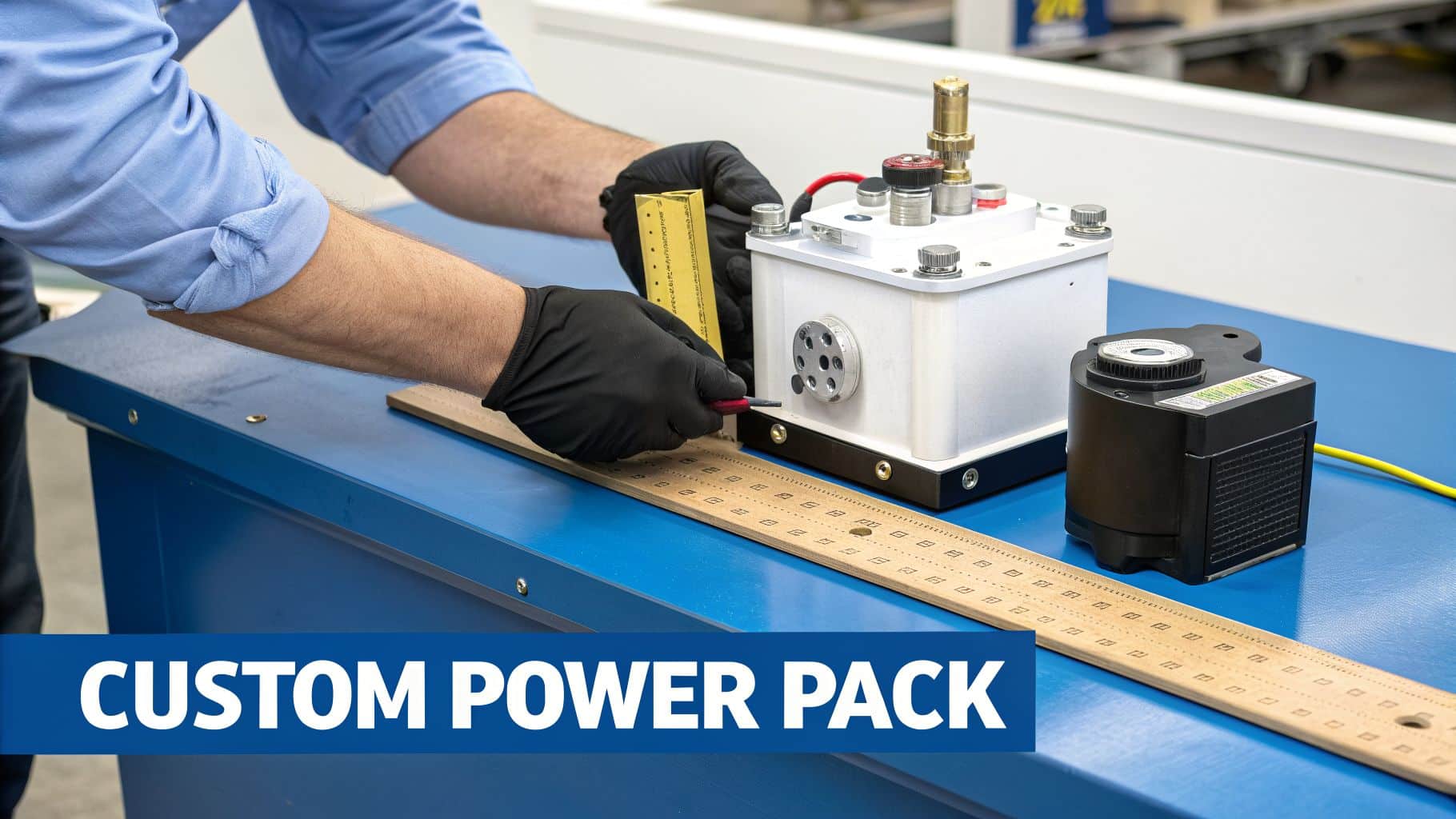
Compact Mini Power Packs: Think of these as the versatile problem-solvers for mobile equipment and lighter industrial jobs. They are often built using a modular system, like the Hydronit range we assemble in-house, which allows for incredibly fast configuration. It’s a bit like building with Lego; we select from a wide range of standard pumps, valves, and tanks to click together the right unit. This approach is perfect for tipper trailers, tail lifts, and small workshop machines where space is at a premium.
Bespoke Industrial Power Packs: Now, these are a completely different animal. These are fully custom-engineered systems, like the industrial power packs up to 11 kW we design and build right here at MA Hydraulics. Every single component is hand-picked for a specific task, and the reservoir and layout are fabricated to fit a precise footprint and meet a demanding performance brief. You’ll find these powering heavy-duty machinery in tough, often continuous-use factory environments.
The Bespoke Design and Build Journey
Choosing a custom power pack is a genuinely collaborative process. It’s about working closely with your hydraulic supplier to ensure the final product is a perfect match for your machine. Drawing from our own in-house process, here’s a look at what that journey typically involves.
It all boils down to a few key stages:
- Initial Consultation: This is where we simply listen. We need to get a deep understanding of the machine’s function, the forces and speeds required, and the environment it will be working in.
- Application Analysis: Our technical team then crunches the numbers. They’ll calculate the necessary flow (LPM), pressure (bar), and figure out which types of components will be the best fit.
- Circuit Design: With the data in hand, we design the hydraulic circuit itself. This is where we map out the ideal combination of pumps, valves, and filtration to deliver the control and efficiency you’re after.
- Component Selection: Based on that design, we select high-quality components from trusted brands that offer the best possible performance and reliability for the budget.
- Assembly and Fabrication: Our engineers then get to work building the unit. This involves fabricating the custom reservoir, mounting all the components, and plumbing the entire system.
- Testing and Commissioning: Before it ever leaves our workshop, the finished power pack is put through its paces. We rigorously test it to make sure it meets every single performance specification.
A bespoke power pack isn't just a collection of parts; it's a fully integrated solution. The design optimises how components interact, reducing wasted energy, minimising heat generation, and delivering a more responsive and reliable system than a mismatched assembly ever could.
This tailored approach is especially valuable for complex machinery in sectors like heavy construction and production material handling. A key part of these integrated systems are hydraulic manifolds, which enable compact and efficient fluid control. The UK market for these components is growing, with forecasts predicting an increase of £2.12 million between 2024 and 2028, reflecting their importance in modern hydraulic design. You can find more details on the hydraulic manifold market outlook and its impact on equipment manufacturing.
Ultimately, choosing a bespoke hydraulic solution gives OEMs and automation projects a powerful advantage, ensuring the heart of your machine is built without a single compromise.
Smarter Procurement Strategies for MRO Teams
For any Maintenance, Repair, and Operations (MRO) team, smart procurement is your best defence against the kind of downtime that grinds everything to a halt. When you’re responsible for keeping machinery running, your approach to sourcing hydraulic components is just as vital as the equipment itself. This isn't just about ordering parts; it's about building a robust system that can see trouble coming, keep costs in check, and drastically shorten the time between a failure and a fix.
Ultimately, the goal for any operation that depends on its hydraulic equipment supply is straightforward: get the right part to the right machine at the right time. A well-thought-out strategy makes this a reliable reality, shifting your team from a constant state of reactive firefighting to proactive control. Here’s a look at some practical strategies to fine-tune your hydraulic parts inventory and procurement process.

Optimising Inventory for Critical Spares
Let's be honest, not all spares are created equal. Stockpiling too much inventory is a sure way to tie up capital you could be using elsewhere, but having too little is an open invitation to disaster. The real skill lies in identifying and prioritising your most critical components—the ones whose failure would cause the biggest headaches, both operationally and financially.
A practical way to manage this is to categorise your spares:
- Critical Spares: These are the high-impact parts with long lead times. If one fails, it means an immediate and expensive shutdown. You absolutely want these on-site and ready to go.
- Essential Spares: These parts are important, but maybe you can get them faster, or there's a temporary workaround. A "just-in-time" approach with a supplier you trust can work wonders here.
- General Spares: Think of your common, low-cost items like standard fittings or seals. These can simply be restocked on a regular schedule without much fuss.
A great way to manage this is by working with your hydraulic supplier to create a "virtual inventory." They hold dedicated stock of your critical parts, ready for immediate dispatch. This gives you the security of having spares on hand without the cost of carrying them yourself—blending the safety of a full stockroom with the efficiency of lean inventory.
OEM vs Aftermarket: The Smart Blend
The debate over Original Equipment Manufacturer (OEM) versus aftermarket parts is a familiar one for any MRO team. OEM parts give you that guarantee of a perfect fit and familiar quality, but they often carry a premium price tag. On the other hand, a top-quality aftermarket part can deliver identical—or sometimes even better—performance for a lot less. For example, a branded pump might cost you £150 instead of the OEM equivalent at £220.
The most effective strategy isn't about picking a side; it's about creating a smart blend. For machinery still under warranty or for highly specialised, unique components, sticking with OEM is often the only sensible choice. But for more standard parts on your out-of-warranty equipment, a quality aftermarket component from a reputable brand offers fantastic value. This is where a knowledgeable supplier becomes invaluable, as they can vouch for the reliability of the aftermarket brands they carry. Of course, getting those parts on time relies on solid logistics, making the process of choosing the right third-party logistics provider a crucial decision.
Single-Source vs Multi-Source Suppliers
Putting all your eggs in one basket by using a single supplier can certainly simplify procurement and help you build a really strong, collaborative partnership. The downside? It also introduces a single point of failure. If that one supplier has stock problems or a logistics nightmare, your entire operation becomes vulnerable.
This is why multi-sourcing—using a few approved suppliers—is so important for building resilience into your supply chain. It gives you options and leverage. For common items that need regular replacement, like a retractable hose reel, having multiple suppliers who can provide a solution is a huge advantage. Often, a balanced approach works best: have a primary supplier you trust for the bulk of your orders, and keep one or two approved secondary suppliers in your back pocket for those critical or hard-to-find components.
More Than Just Parts: Finding a True Hydraulic Partner
When all is said and done, hydraulic equipment supply isn't just about ordering a component from a catalogue. It's about building a partnership. Real success comes from a blend of quality parts, specialist technical support, and a supplier you know you can rely on when a critical machine goes down.
We've covered how to pinpoint the right components, what to look for in a supplier, and why a bespoke build is often the smartest move for peak performance. A true specialist should feel like an extension of your own team. At MA Hydraulics, that's exactly our aim—backed by a huge stock of trusted brands, our own in-house customisation workshop, and the deep-seated expertise it takes to find those rare or obsolete parts. Our job is to keep your systems running smoothly, reliably, and without the expensive downtime that hurts your bottom line.
Expertise on the Shelf, Not Just on the Phone
Your operation can't afford to wait. That’s why a supplier with both technical brains and a warehouse full of stock is so valuable. Having the right inventory on-site can be the difference between a week-long shutdown and a next-day fix. We’ve built our business by combining hands-on engineering know-how with an inventory that holds thousands of quality components from names like Vivoil and Hydronit.
This approach means you get the right solution, right away. Whether it’s a standard gear pump you need this afternoon or complex fluid power services to get to the root of a recurring issue, having a single, knowledgeable point of contact makes everything simpler and gets you back to work faster.
A great hydraulics partner doesn’t just sell you a part. They give you the confidence of knowing expert advice, quality components, and a dedicated team are ready to solve your problem—fast.
We strive to be that partner for your business. We're here to offer practical advice and hands-on support for your next project, making sure you get a solution built to last.
Your Hydraulic Equipment Questions, Answered
When you're dealing with hydraulic equipment day in and day out, practical questions are bound to come up. Whether you’re an engineer designing a new system, a procurement manager sourcing parts, or a maintenance professional keeping things running, you need clear, no-nonsense answers.
We get these kinds of questions all the time. Here are our expert takes on some of the most common challenges we help our clients solve.
How Do I Identify a Replacement for an Obsolete Part?
First, gather all the intel you can from the old component. Look for the manufacturer's name, any part numbers stamped or engraved on the housing, and any other visible specifications. It’s also a massive help if you can take a few clear photos from different angles.
Once you have that information, get in touch with a specialist supplier like us. Our technical team has years of experience cross-referencing old, hard-to-find parts to modern equivalents from trusted brands like Vivoil or Hydronit.
Sometimes, a direct, one-for-one swap just doesn't exist anymore. In that case, we change tactics and focus on the part's job. By understanding its core specifications—like flow rate (in Litres Per Minute), pressure rating (in bar), port sizes, and mounting type—we can pinpoint a functional equivalent. This approach ensures the new component will slot right into your system with little to no modification, getting your machinery back online fast.
What Is the Difference Between a Mini and a Bespoke Power Pack?
Think of a mini power pack as a compact, off-the-shelf solution. They're modular units built from standard, interchangeable parts, perfect for mobile machinery or lighter industrial jobs where space is tight. Their design allows for quick assembly to meet a wide range of common needs.
A bespoke industrial power pack, on the other hand, is a completely custom-engineered system designed from the ground up for a specific, often heavy-duty, application. Here at MA Hydraulics, we design and build these systems in-house for tasks requiring up to 11 kW of power.
This bespoke process involves designing a unique hydraulic circuit from scratch, hand-picking specialised components for the best possible performance, and even fabricating a custom-sized reservoir to fit a precise footprint. The end result is a powerhouse built for one specific job, and to do it perfectly.
How Important Is the Brand of a Hydraulic Component?
Honestly, it’s critical. A component’s brand is your best indicator of its quality, reliability, and how it will perform over the long haul. Established names like Vivoil and OMT pour huge resources into R&D and strict quality control, which means their parts are built to precise tolerances and can be trusted to perform under pressure.
A non-branded or generic part might look tempting on paper. For instance, a generic pump could be £50 while its branded equivalent is £75. But that initial saving rarely tells the whole story.
When that cheaper part fails prematurely—and it often does—the real costs mount up quickly. You’re looking at expensive downtime, extra labour for the replacement, and the risk of collateral damage to other expensive parts in your system. A good hydraulic equipment supply partner always stands by proven brands because it protects your machinery and your bottom line.
What Information Do I Need for a Hydraulic System Quote?
To get a quote that's truly accurate and helpful, the simple answer is: the more detail, the better. Giving us a full picture of what you need to achieve allows us to spec a system that will perform exactly as you need it to.
The absolute essentials we need to know are:
- Required Flow Rate: How many litres per minute (LPM) does it need to move?
- Maximum Operating Pressure: What is the peak pressure in bar?
- System Function: What will the hydraulics actually do? (e.g., lift a platform, press a mould, rotate an arm).
- Prime Mover Details: What's driving it? An electric, petrol, or diesel motor, and what is its power rating (kW or HP)?
- Space Constraints: Are there any specific dimensions the unit has to fit into?
If you're just replacing a part, the original part number is gold. It's the single most valuable piece of information you can give us. The more you can tell us, the better we can match the components to deliver the performance your system demands.
Ready to find the right hydraulic solution for your needs? Phone 01724 279508 today to speak with our technical team, or send us a message for expert advice and support.
